Do You Need Cambering for Your Projects?
At Service Steel, we offer a range of finishing services to ensure that you get steel that fits your requirements. This is because when steel is shipped from a mill, it’s often done in standard sizes and shapes that won’t necessarily be the final product you need. Having an intermediate step where your steel is processed and tailored to your individual specifications is crucial. Our cambering and bending services not only give more strength to your steel beams and structural steel products, but give them a custom shape and size for construction projects such as bridges.
Steel Bending & Cambering Services
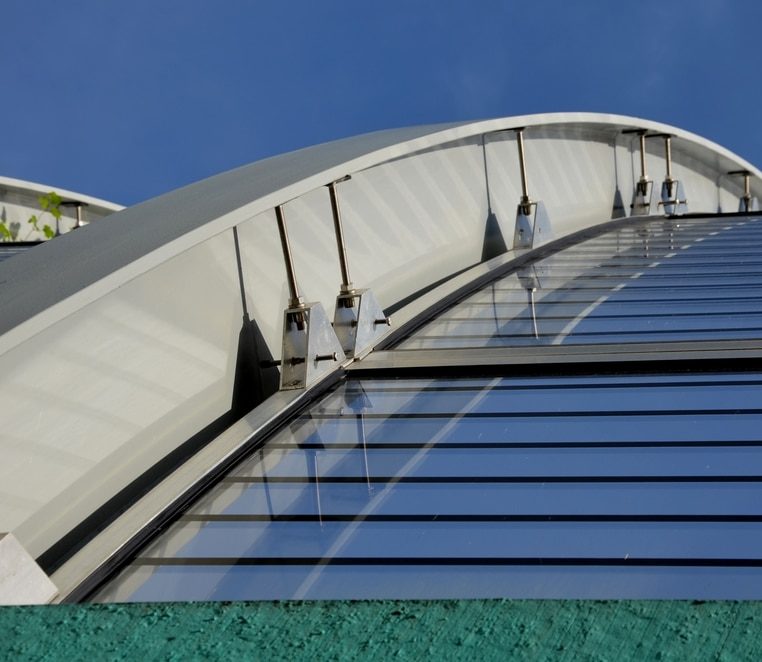
Bending steel products is performed by creating a curve along the long axis of a piece of metal, or turning a straight beam into an arc. Bending can either be considered camber (bending along the vertical axis) or sweep (bending along the horizontal axis). Cambered beams and structural steel can support vertical forces more efficiently because of their shape’s weight distribution and give a different aesthetic look to your project. Sweep can provide additional support to a canopy against the weak axis. Either category of bending is usually achieved by using a cambering machine that holds the flat steel product at either end, then applies pressure from hydraulic cylinders between each end to bend the steel. This bending point is often the perfect center of the product’s length, but can be offset to different areas of the beam depending on specifications. Call our team of experts or request a quote today.
Bending & Cambering FAQs
Cambering introduces a slight, intentional curve into steel beams to counteract the deflection that occurs under load. This proactive measure ensures that floors remain level during construction and over time, preventing sagging and maintaining structural integrity. It’s particularly beneficial in applications like concrete floor systems, where cambering compensates for the weight of the slab and live loads.
Cambering a steel beam, especially through cold bending, increases its yield and tensile strength. However, this process can decrease its ductility and toughness. It’s essential to balance cambering with the beam’s intended use to ensure it performs adequately under expected loads.
Steel beams are the primary product that cambering or bending is used for. However, channels and angles can also be cambered for construction and structural applications.
While cambering can be applied to various steel profiles, there are practical limits based on beam size and weight (larger and heavier beams may require specialized equipment) and camber degree (excessive camber can lead to issues with rebar cover and floor topping thickness). We recommend speaking with our team to determine the feasibility of cambering for specific sizes and profiles.
Yes. Machines allow cambering to be applied off-center to accommodate specific design requirements. This flexibility allows for adjustments in beam placement and load distribution, supporting complex architectural and structural designs. It’s particularly useful in scenarios where beams need to align with non-standard layouts or where load paths are unconventional.
Camber refers to a bend or arc along the beam’s vertical axis (in line with its web), while sweep refers to a bend or arc along the beam’s horizontal axis (in line with its flanges). Both are used to achieve specific structural or aesthetic outcomes but differ in their application and impact on the beam’s performance.
We mostly employ cold cambering methods using hydraulic machines. This method is preferred for its speed, accuracy, and cost-effectiveness, allowing for precise control over the cambering process and reducing the risk of over-cambering or the need for corrective measures.
Cold cambering offers several advantages over heat bending:
- Efficiency: Faster processing times.
- Cost-Effectiveness: Lower operational costs.
- Precision: Greater control over the cambering process.
- Reduced Material Waste: Less need for rework.
These benefits contribute to more efficient project timelines and reduced overall costs.
Yes. Cambering can lead to cost savings by allowing for smaller beam sizes. By compensating for deflection, cambered beams can reduce the need for larger, more expensive beams. Cambered beams can decrease the overall height of the floor system, creating more usable space and reducing material costs.
Cambering is particularly beneficial for beams used in floor systems, bridges, and other structures where deflection under load is a concern. However, it may not be suitable for cantilevered beams or crane beams, where the dynamic loads and stress concentrations differ significantly from those in typical floor systems. It’s essential to consult with a structural engineer to determine the appropriateness of cambering for specific applications.